
Martin-Luther-Universität Halle-Wittenberg

Links

Weiteres

Login für Redakteure


Herbarium


Curator (Kustos)

Preparator (Präparatorin)

Address (Anschrift)

Institut für Biologie, Bereich Geobotanik und Botanischer Garten, Herbarium Neuwerk 21 D-06099 Halle (Saale) (Germany)

  • This herbarium was founded in 1812 by the purchase of the collections of the famous botanist C. Schkuhr. - D.F.L. v. Schlechtendal had been Professor of Botany and Director of the Botanical Garden at Halle (Saale) between 1833 and 1866. His influence on the development of our herbarium was enormously important. In 1866, after his death, his herbarium encompassed an arranged part of about 70.000 specimens and numerous additional non-arranged collections. One year later, his herbarium was purchased by the University Halle. It represents the historic basis of HAL. - HAL comprises about 500.000 specimens of higher and lower plants as well as fungi from all parts of the world, with a special focus on Europe, Australia, South Africa and Central to South America. - HAL is composed of a general herbarium of higher plants (worldwide), a local herbarium (Hercynian area), some separate special collections (e.g. plants of Mongolia) and various collections of cryptogamic plants (algae and mosses), fungi and lichens. - Loan requests have to be sent to the curator of the herbarium (only for insitutions, e.g. herbaria, institutes, museums). Scans of particular specimens can be prepared and sent on request.
  • (Das Herbarium wurde durch den Ankauf der Sammlung des bekannten Botanikers C. Schkuhr im Jahre 1812 begründet. - D.F.L. von Schlechtendal war von 1833 bis 1866 Professor für Botanik und Direktor des Botanischen Gartens in Halle. Sein Wirken war für das Hallesche Herbarium von ausschlaggebender Bedeutung. Als er 1866 starb, enthielt der geordnete Teil seiner Sammlung 70.000 Arten, dazu kamen große Mengen ungeordneter Pflanzen. Ein Jahr später kaufte die Universität Schlechtendals Herbarium, das noch heute den Grundstock der Halleschen Sammlung darstellt. - Es existieren ca. 500.000 Belege höherer und niederer Pflanzen sowie Pilze aus aller Welt, mit Schwerpunkt auf Europa, Australien und Mittel- bis Südamerika. - Das Hallesche Herbarium besteht aus einer weltweiten Hauptsammlung höherer Pflanzen, einer Heimatsammlung (Herzynisches Gebiet), einigen Spezialsammlungen (z.B. Mongolei-Herbarium) und verschiedenen Kryptogamensammlungen (Algen, Moose, Flechten, Pilze). - Anfragen zur Ausleihe von Material sind an den Kustos des Herbariums zu richten. Sie erfolgen nur an Institutionen (Herbarien, Institute, Museen). Scans von Typen können auf Anfrage angefertigt und geliefert werden.)

Type material of the Herbarium HAL (Typusmaterial des Herbariums HAL)

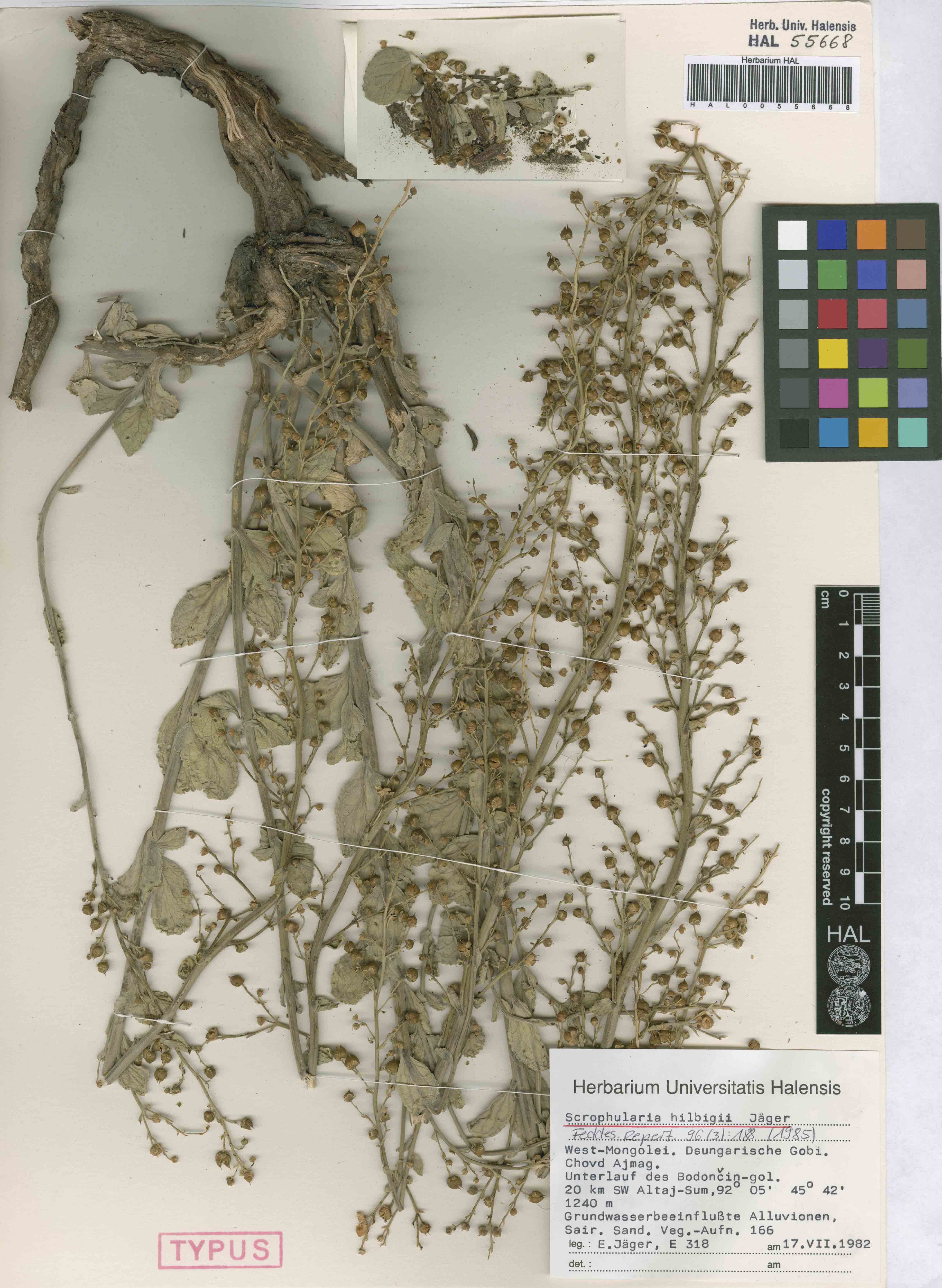
  • Type material of HAL is separately stored. Currently it comprises more than 3500 names. The herbarium of D.F.L. v. Schlechtendal represents the historic basis of HAL. Numerous types of taxa described by Schlechtendal (1164 species and 44 varieties and formae) are maintained at Halle (types of 747 taxa are present at HAL). All names have been proven. The results have been published by Braun & Wittig (Schlechtendalia 10: 15-65, 2003), and all data have been put into the 'Typus database' of HAL. If the type material of a particular taxon is not preserved at HAL, the note 'Not at HAL' is given (missing types often refer to taxa described by Schlechtendal before he moved away from Berlin to Halle in 1833). For all other collections and authors (Werner 1988, Braun 1994), only type specimens preserved at HAL are listed (e.g., H.H. Behr, A. v. Chamisso, J.F. Drège, C.F. Ecklon, C.A. Ehrenberg, A. v. Humboldt, R.A. Philippi, P. Salzmann, C.J.W. Schiede, C. Schkuhr, F. Sellow, F.W. Sieber, C.L. Willdenow, C.L.P. Zeyher, etc.). They are to be found in the 'Typus database' and partly in some publications on types of taxa belonging to particular plant families (see below). The herbarium of K. Sprengel, the predecessor of Schlechtendal in Halle, is not at HAL, except for some duplicates, e.g. in herb. Schkuhr and Schlechtendal. Currently a systematic search for additional types housed at HAL is in progress, and a project dealing with the scanning of all types of taxa described from Africa and South America has been initiated. The scans will later be put into our database in order to be available for the public. The particular types are marked as 'holo-, iso-, lecto-, neo-, syn- or paratype' (if the status is unclear, only 'type' is given).
  • (Typusmaterial des Herbariums der Martin-Luther-Universität wird getrennt von der Hauptsammlung aufbewahrt. Gegenwärtig sind mehr als 3500 Namen enthalten. Das Herbarium von D.F.L. von Schlechtendal stellt den historischen Grundstock von HAL dar. Zahlreiche Typen der etwa 1200 von Schlechtendal beschriebenen Taxa (1164 Arten und 44 Varietäten und Formen) sind in Halle vorhanden (Typusmaterial von 747 Taxa ist in HAL erhalten). Alle Namen wurden überprüft. Die Ergebnisse wurden von Braun & Wittig (Schlechtendalia 10: 15-65, 2003) veröffentlicht und alle Daten sind in die 'Typus-Datenbank' von HAL eingegangen. Wenn Typusmaterial einzelner Taxa nicht in HAL vorhanden ist, wird 'Not at HAL' angegeben (fehlende Typen beziehen sich oft auf Taxa, die vor 1833 beschrieben worden sind, bevor Schlechtendal von Berlin nach Halle umgesiedelt war). Für alle anderer Sammler und Autoren (Werner 1988, Braun 1994) werden Typusangaben nur gemacht, wenn auch wirklich Typen in HAL vorhanden sind (z.B. H.H. Behr, A. v. Chamisso, J.F. Drège, C.F. Ecklon, C.A. Ehrenberg, A. v. Humboldt, R.A. Philippi, P. Salzmann, C.J.W. Schiede, C. Schkuhr, F. Sellow, F.W. Sieber, C.L. Willdenow, C.L.P. Zeyher). Sie sind dann in der Typusdatenbank zu finden und z.T. in einzelnen Publikationen zu Typen von Arten spezieller Familien (siehe unten). Das Herbarium K. Sprengel, dem Vorgänger von Schlechtendal in Halle, ist nicht in HAL, nur einzelne Duplikate, z.B. in herb. Schkuhr und Schlechtendal. Gegenwärtig wird eine systemastische Suche nach weiteren in HAL vorhandenen Typen durchgeführt. Weiterhin hat ein Projekt zur Digitalisierung aller Typen von Sippen, die aus Afrika und Südamerika beschrieben worden sind, begonnen. Die Bilder werden später in die Typusdatenbank eingeladen und der Öffentlichkeit zugänglich gemacht. Die einzelnen Kollektionen werden als "Holo-, Iso-, Lecto-, Neo-, Syn- oder Paratypen" gekennzeichnet. Ist der genaue Status der Kollektion nicht bekannt, wird nur "Typus" vermerkt.)

please select under "Institution" Herbarium HAL (bitte in "Institution" auf "Herbarium HAL" gehen und auswählen)

Particular lists of types according to taxonomic groups (Einzellisten der Typen nach taxonomischen Gruppen:

Cryptogamic plants and fungi (Kryptogamenpflanzen und Pilze):

Bryophyta Fungi Lichenes Pteridophyta Gymnospermae

Spermatophyta:

Annonaceae Apiaceae Apocynaceae Asclepiadaceae Brassicaceae Gentianaceae Loganiaceae Menyanthaceae Myrtaceae Ranunculaceae

References (Literatur):

BRAUN, U. (1994): Das Herbarium. S. 295-302. In R.-T. SPELER (Hrsg.): 300 Jahre Universität Halle-Wittenberg, 1894-1994, Schätze aus den Sammlungen und Kabinetten. Stadt Karlsruhe, Martin-Luther-Universität Halle-Wittenberg. WERNER, K. (1988): Zur Geschichte des Herbariums der Martin-Luther-Universität Halle-Wittenberg nebst Anmerkungen zu einigen Sammlungen. Hercynia N.F. 25(1): 11-26.

Zum Seitenanfang